As president of SNAME it gives me great personal pleasure to write this welcome note to the 2014 Classic Yacht Symposium as this will be a very important forum not only for all involved with classic yachts, but also for all naval architects, yacht and boat designers.
SNAME was founded in 1893 with the following objectives:
“The objectives of the Society are to advance the art, science, and practice of naval architecture and marine engineering in all their applied forms including the construction and operation of ships, marine vehicles, and structures of all kinds and the arts and sciences allied thereto by affording facilities for the exchange of information and ideas among its members and placing on record and disseminating the results of research, experience, and information relative to the objectives.”
While not exclusively mentioned, the design of yachts and other small craft have been a staple for SNAME members over the years and I firmly belief that much innovation has come from that sector of our profession.
In my own case, I grew up in Scotland and spend my formative years on the Clyde coast almost equidistant from the design offices of G.L. Watson and the yacht building yard of William Fife. As a teenager I sailed on many yachts designed by each of these legends.
Slightly later in life while studying for a degree in naval architecture at the University of Glasgow, I was apprenticed to the small Clydeside shipyard of Wm. Denny Bros., whose place in maritime history is secured by the fact that they finished and delivered the clipper ship Cutter Sark to her owners when the original shipyard went out of business during her construction. A further important vessel to come from the Denny yard was one of Sir Tommy Lipton’s, America’s Cup Challengers, Shamrock II and Shamrock III. I remember we had plating half models of these fine hulls in our drawing office which had been used to take of plate sizes in the days before CAD-CAM programs.
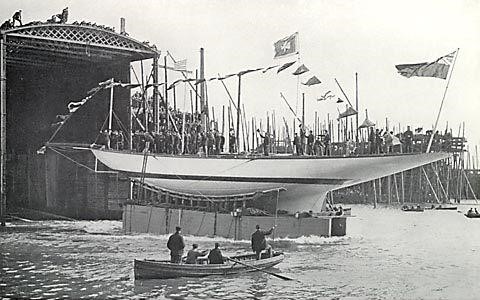
Launching of the Shamrock III from Denny’s shipyard in Dumbarton, Scotland in 1903
The importance of studying classic yachts to the practicing naval architect cannot be overstated. Today’s classic yachts were the cutting edge technology of yester-year and because of the nature of yachting they remind us of the importance of experimentation and feed-back, as key processes in design.
Many classic yachts were developed to win races and incorporated many features which became used in other areas; composite wood/metal construction, better understanding of sail aerodynamics, bi-metallic hulls, advanced rigging techniques, etc. A winner did not usually stay a winner for long and there was (and still is) a strong element of learning from the design of the day by discovering ways to improve, and then making a new design with better performance. In the past, there have been times of rapid innovation in yacht design where an owner was sponsoring new improved designs in quick succession. The motivation to win and the money with which to accomplish it was a key factor in accelerating design innovation and the adoption of new technology.
For example, when Mortan F Plant took his schooner the Ingomar, one of the first schooners designed by Nat Herreshoff, to Europe in the early 1900s, there was much speculation in the yachting press, to which the owner is reported as replying as follows. “While my trip to England and Germany is not for racing purposes, as I am not a ‘mug hunter,’ I do propose making a cruise and if we should be in the vicinity of racing and invited to do so, we will be glad to participate”. He went on to compete in a number of races in both England and Germany and Ingomar won 17 prizes including 12 firsts!
A further lesson which is worth noting is that these classic vessels, full of exquisite design detail, high craftsmanship and technological innovation were generally the product of a single mind (assisted by others of course but led by one designer).
In these days when we see so much design by committee, it is refreshing to think back to an earlier time when John Scott Russell, the great Victorian naval architect was able to state in his massive text book, The Modern System of Naval Architecture, published in1865:
“A naval architect should be able to design, draw, calculate, lay down, cut out, set up, fasten, fit, finish, equip, launch and send to sea a ship out of his own head. He should be able to tell beforehand at what speed she will go, what freight she will carry, what qualities she will show in a sea, - before it, athwart it, against it, - on a wind, close hauled, going free, - what she will stow, and carry, and earn and expend. On his word you should be able to rely, that what he says, that his ship will infallibly do.
I encourage as many of my SNAME colleagues as possible to attend the 2014 Classic Yacht Symposium and to spend time observing examples of these fine craft to learn how to become better naval architects and designers. From first-hand experience I can tell you that even a designer of icebreakers and offshore rigs can learn from the past masters of the art of designing for the ocean environment.
Peter G. Noble
President
SNAME
The International Community for Maritime and Ocean Professional