.
EVENT DESCRIPTION
Join the New York Metro Section for a presentation by CDR Christopher G. MacLean, USN, PE and LT Jonathan J. Daus, USN and PhD Candidate in the Department of Mechanical Engineering at MIT.
Hear about the Engineering Duty Officer Community (EDO) in NAVSEA, the MIT 2N Program, NEXUS and Academia engagement at large. The technical presentation by LT Jonathan J. Daus, USN will be on his research in magnetohydrodynamic (MHD) propulsion.
.
ABSTRACT
Due to the ever-increasing demand for advanced stealth technology in the undersea domain, coupled with significant progress in superconducting technology, magnetohydrodynamic (MHD) propulsion has once again emerged as a topic of considerable interest. In May 2023, the Defense Advanced Research Projects Agency (DARPA) Defense Sciences Office (DSO) launched the Principles of Undersea Magnetohydrodynamic Pumps (PUMP) program, soliciting designs and prototype developments of MHD propulsors for naval applications. While most research efforts have focused on conduction-based systems, this work investigates the feasibility of an induction-based MHD propulsor for submarines.
For this study, the DARPA SUBOFF bare hull was modeled using full-scale parameters to closely represent a modern submarine. Both theoretical analyses and multiphysics simulations were developed to explore the design trade space within practical limitations. Magnetic fields were modeled using high-temperature superconductor (HTS) tapes capable of generating flux densities up to 20 T, supporting submarine speeds of up to 40 knots. Initial designs incorporated a shrouded propulsor design, but intermediate results shifted focus towards shroudless designs.
This work presents innovative methods to improve the traditionally low efficiencies of MHD systems by mitigating finite-length (end) effects. Furthermore, results show that an induction-based design can be integrated within an existing submarine hull, eliminating the additional drag penalties typically associated with ducted MHD systems. The research demonstrates that induction-based MHD propulsors can generate sufficient thrust to propel the DARPA SUBOFF bare hull at speeds exceeding 30 knots, achieving efficiencies greater than 60% at speeds up to 20 knots.
An overview of the graduate-level Naval Engineering Program at MIT will also be presented.
.
AGENDA
17:00 Cash Bar Opens
18:00 Buffet Dinner
19:00 Presentation
.
SPEAKERS/PRESENTERS
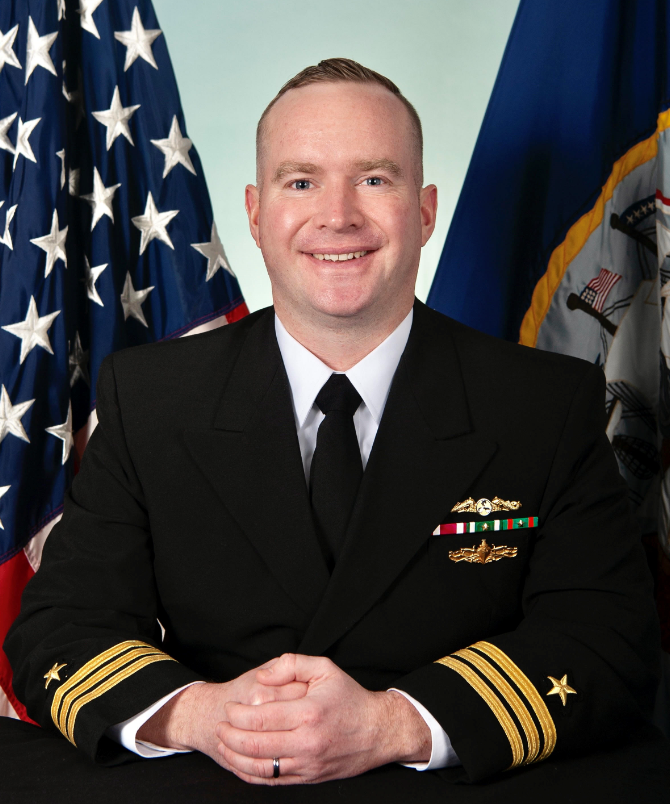
CDR Christopher G. MacLean, USN, PE, is Professor of the Practice in the Mechanical Engineering Department at Massachusetts Institute of Technology (MIT) and the Academic Officer for the Naval Construction and Engineering (2N) Program. He commissioned in 2007 from Tulane University and earned his Naval Engineer’s and Mechanical Engineering Master’s from MIT in 2012. Through his career he has served on in-service ships and submarines and has led multiple design, maintenance, modernization, and new construction programs as an Engineering Duty Officer.
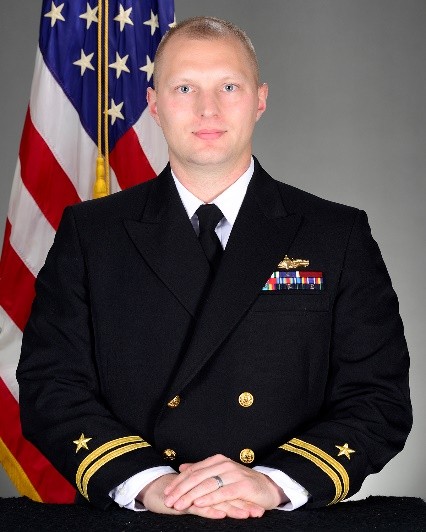
LT Jonathan J. Daus, USN, is a PhD Candidate in the Department of Mechanical Engineering at the Massachusetts Institute of Technology. He commissioned out of the United State Naval Academy in 2017 before serving two tours on the USS SAN DIEGO (LPD 22) as a Surface Warfare Officer. In his transition into the Engineering Duty Officer community, he received his Naval Engineer’s degree from MIT in 2024.
.
This presentation is expected to be accredited for 1 PDH. To obtain PDH credit, participants must attend the meeting and submit a completed Learning Assessment and Application Form directly to SNAME.
#In-PersonEvent